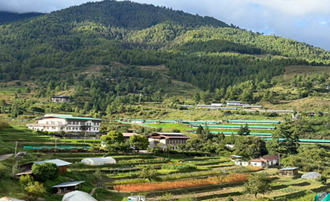
The National Centre for Organic Agriculture (NCOA) was originally established in 1969 as the Horticulture Research Station, and was later renamed as NCOA in 2020 as the apex body for coordinating and facilitating the development of organic agriculture in Bhutan. NCOA is under the Agriculture Research and Extension Division (ARED) of the Department of Agriculture (DoA), responsible for regulating and certifying organic farms in accordance with the Bhutan Organic Guarantee System (BOGS) and the Local Organic Assurance System (LOAS).
NCOA has five programs: Horticulture program (temperate fruits, nuts, vegetables, medicinal and aromatic plants), Field Crops Program (high-altitude rice and related organic technologies), National Potato Program (nationwide potato research and development activities), Technical Support Services Program (organic technology development and outreach activities), and Policy, Regulation, and Coordination (organic registration, certification, and regulation).
At the national level, NCOA implements policies and decisions of the National Organic Board (NOB) and National Technical Working Group (TWG), manages organic registration and certification, leads research and development, maintains the national organic database, and coordinates major programs such as potato, vegetable, and quinoa. Regionally, it serves western Bhutan—Thimphu, Paro, Haa, and Chhukha—by delivering technical support, training, and demonstrations to farmers, promoting the growth of organic agriculture.
Organic certification is a process designed for producers of organic food and other agricultural products to ensure that their practices meet specific standards. While certification requirements differ from country to country, they generally include a set of production guidelines covering cultivation, storage, processing, packaging, and marketing. These standards prohibit the
Bhutan promotes organic farming through two certification systems to ensure product authenticity and credibility, thereby facilitating and supporting both the domestic market and exports. These are the Local Organic Assurance System (LOAS) and the Third-Party Certification system, both of which are based on Bhutan Organic Standards (BOS).
1. Local Organic Assurance System
· The LOAS is a certification scheme managed by the National Centre for Organic Agriculture (NCOA).
· It is intended primarily for the domestic market, however, can be used for export if accepted by the importing country.
· It is applicable for commodities that are unprocessed or have only undergone primary on-farm processing (such as drying, shelling, grinding, cutting, and curing) without using any additives.
· Certification under LOAS allows them to label and sell their products using the Bhutan Organic Mark.
Third-Party Certification Procedure | ||
Steps |
|
|
1 | Application | The interested applicants must submit an application with the necessary information to BFDA in the prescribed form, available from www.bfda.gov.bt |
2 | Application Review | BFDA reviews the application to assess the readiness of the applicants for organic certification. |
3 | Field Audit | After registration, BFDA carries out on-farm inspection on a mutually agreed date, as per Bhutan Organic Standards. |
4 | Review process | After inspection, the evaluation reports are reviewed to ensure that it fulfils the organic standards and certification requirements and a recommendation for the grant of certificate is made to Certification Committee of BFDA |
5 | Certification decision | The decision for the grant of certification is made by BFDA’s Certification Committee and applicant is informed of the Committee’s decision. |
6 | Grant of certificate | For successful applicants, BFDA issues a license and agreement on the use of the Certification Mark is signed between BFDA and applicants. |
7 | Recertification | The validity of the certificate is for three years, and surveillance will be conducted by BFDA at the site at least once a year to ensure continued fulfillment of Bhutan Organic Standards. The client is required to apply to BFDA for renewal before the license expires. |
The Bhutan Organic Mark is a trusted mark that distinguishes certified organic products from conventional goods. It guarantees that the product has been grown and processed in accordance with organic principles and standards, without the use of synthetic chemicals, pesticides, or genetically modified organisms (GMOs). For consumers, it serves as a symbol of purity, health, and sustainability.
The Bhutan Natural Mark is endorsed and implemented on 26th November, 2024 with the approval from the 21st Technical Working Group meeting on Organic Agriculture. The mark will be exclusively used to facilitate the export of Bhutanese food and agricultural products, where Bhutanese organic certifications are not accepted. However, the BNM will be issued only for food and agricultural products certified under the Local Organic Assurance System (LOAS) or Third-Party organic certification issued by the Bhutan Food and Drug Authority (BFDA). By providing a recognizable and trusted branding for Bhutanese food and agricultural products, the mark could open up new export market opportunities.
This mark will remain as a property of the Ministry of Agriculture and Livestock (MoAL), and the mark has been registered for Intellectual Property (IP) right with the Department of Media, Creative, Industry and Intellectual Property (DoMCIIP) under the Ministry of Industry, Commerce and Employment (MoICE).