
Hello, everyone. I’m Yukiko Matsuura, store manager of our organic shop. This is my second post here thank you for reading.
Today I’d like to share what I’ve learned about building a shop over the thirty-some years since we first opened.
When we started, we set up a table in our own driveway a space just big enough for one car and held a market on Sundays. It was a quiet residential neighbourhood, so I’m sure our neighbours wondered what on earth was going on.
In Japan at that time, most people believed crops simply couldn’t grow without pesticides or fertiliser. So, sadly, we were sometimes seen as a “suspicious shop.” There were people who looked around inside while saying unkind things, and then left.
I was in my twenties then, proud in the way the young often are, and being embarrassed was painful to me. I remember how bitter and angry I felt. I don’t want to be beaten by this, I thought. What should I do?
And that was when I realise what mattered was having the knowledge to answer with confidence, and creating a shop that felt welcoming rather than strange. Not appealing to fear, not telling people how frightening pesticides or synthetic food additives are, stirring up their anxiety and urging them to eat “safe” food. Instead, I have tried to build a shop that conveys the deliciousness of food that is good for the soil, good for the grower, and good for the person eating it.
In Bhutan, many farm stands are right by the roadside. Rather than sitting among houses, they appear suddenly along the way. Drivers are usually heading somewhere else, and happen to pass a stand I imagine that’s often the case. Our shop has something of the same quality, so let me gather a few things from our experience that might be useful to you in Bhutan.
I think about shop-building from three angles.
The Seen
1.How to attract new customers
2.how to bring existing customers back.
The Unseen
3. Adding your feeling to the product

1. How to attract new customers
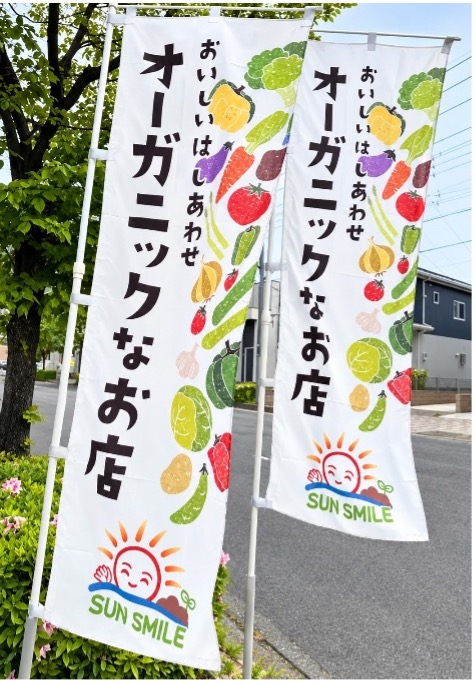
A lively-looking shopfront matters a great deal. Use banners, signboards, and posters — find ways to catch the eye. And when banners or posters fade or tear, replace them right away.
It isn’t only decoration, though. Voices and smiles matter just as much.
A cheerful “Hello!” or “Welcome!” from the shopfront or inside. Or even if the voice doesn’t carry that far, a shopkeeper who is always smiling, visible from outside. These make a wonderful impression — and you can start them any time, at no cost at all.
I don’t mean standing inside facing the road with a fixed smile. I mean staff and customers chatting happily around a fire out front, or someone wiping down the shelves with a naturally bright expression.
Would you want to go into a shop where it’s silent, and the staff are all looking bored, fiddling with their phones? I don’t think so.
On banners and posters: keep some of them
constant your shop’s name, or your slogan. When
someone passes by several times and sees the same
thing again and again, they begin to recognise you.
That recognition comes first.
The trick with banners is to place two or more together, close to each other.
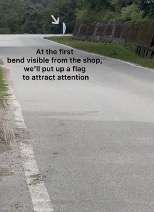
And here is something I felt would be especially effective for roadside shops in Bhutan: put a banner 200 to 300 metres before your shop. If your shop sits along a winding mountain road, placing one at the nearest curve works well too. Cars slow down for a curve and start to accelerate coming out of it, so by the time they reach your shop they may be moving fast. But if there’s an intriguing banner at the curve, they’ll wonder “what’s that?” and won’t speed up so quickly.
Most of your customers arrive by car. They can’t stop suddenly once they spot your shop, so this small preparation really helps. Try putting up a sign that says: Organic farm stand ahead!
Then place exactly the same banners at your shopfront, again two or more together. The sameness is the point — so that people think, “Ah, here it is!” the moment they see them.
If you have a toilet, adding “Toilet available” to that distant banner is highly effective. You could even charge a small fee for using it. On a long mountain road, there will always be someone in need. Whether or not they buy something, very few people will use the toilet and then leave without looking at your shop!

At our shop, every Saturday we put up a tent out front and
sell freshly fried croquettes, with staff calling out cheerfully.
It’s been very popular some people come especially just for the croquettes.
Even if they have no interest in organic food, a delicious croquette
bought in passing can lead to “I wonder what else they sell here?”
Doing something enjoyable at your shopfront is wonderful publicity.
In Japan, stone-roasted sweet potatoes are much loved,
and the smell alone draws people in.
When you hold something like this, my advice for the sign is: write just the one word — “Croquettes” or “Roasted sweet potato” — large enough for a driver to read, and display it at your shopfront or by the road. The key is not to write much. It isn’t the organic vegetables but the roasted sweet potato that brings them in first — and from there, the connection grows.
2. How to bring existing customers back
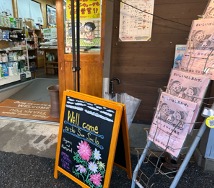
This is about signs that change regularly.
Alongside your permanent banners,
put up posters or boards with recommended items,
and decorations that carry the feeling of the season
a poster with seasonal flowers, say. Or in summer,
wouldn’t it be lovely if a cool little pinwheel spun
beside the display of vegetables?
In Bhutan especially, many shops are open to the breeze, so it would be a shame not to make use of the natural wind! This kind of small warm touch is what we in Japan call omotenashi — hospitality. It means offering something beyond what you sell: a sense that this place somehow soothes you. Even something as simple as thin strips of cool-coloured cloth fluttering in the wind becomes real hospitality for your customers.
Doing this gives the impression that something is always happening — that the shop is alive. Writing something large and putting it up also works beautifully: “This year’s aubergines are excellent!” or “We’ve harvested our finest potatoes!”
Next, the voice.
This is my personal view, but in Bhutan I wouldn’t recommend “Welcome” as your greeting. In Bhutan, where the bonds between people are much closer than in Japan, it may feel a little formal. Instead, if you say “Hello!”, your customer can say “Hello” back. “Welcome” is one-directional — there’s nothing for the customer to answer.
At our shop, we greet people with “Welcome!
Hello.” Not “Hello! Welcome” — the order
matters. By saying “Hello” after “Welcome,” the
customer finds it easy to answer with “Hello.”
And customers who answer will almost always
look at your face. That’s when you smile and now
you’re ready for a conversation. You don’t need
to keep talking right away. You can speak to them
while they’re enjoying their shopping. Because
they’ve already looked at you once, the door of their heart is open.

For someone visiting the second or third time, rather than going straight to your recommendations, ask about them first: “How have you been?” Then tell them what you’d recommend. Build trust, little by little. If a customer feels that this member of staff is thinking of them, they’ll want to come back of their own accord.
Customers come for the staff. However wonderful the shop is, if the staff have no warmth, the result will be disappointing.
Many people who visit an organic shop care deeply about health and beauty, and many are already living with an illness or skin trouble. Talking with them, standing alongside them, matters enormously if you want them to keep coming back for years.
3. Adding your feeling to the product
And here is the heart of it: being a shop that conveys the feeling of every producer behind each thing you sell — the vegetables, the rice, the seasonings, the processed goods.
Show respect for nature and for the growers. Care about your shelves so the products shine, clean them thoroughly, keep everything spotless. These are gifts that nourish our health, so handle them with care. Never touch them in a bad mood.
I speak to the vegetables every day. Thank you. Will you find a home somewhere today? You look lovely today. I talk to them as I would to my own children. It might be a little embarrassing if someone saw me. But strangely, feeling does pass into things.
Let me share two short stories.
The first is something our president, Tomonori Matsuura, once saw through.
There was a farmer who always delivered delicious carrots. Then one day, the taste of the carrots changed.
Matsuura asked him, “How have you been lately? Has something happened with your girlfriend, by any chance?”
The farmer replied, “How could you possibly know that?!” — in tears.
His heartbreak had passed into the carrots.
The second. A member of our staff had been low for days, weighed down by a worry. The fruit he touched began to spoil — only in the places where his hands had been. It didn’t happen with the other staff. It astonished me.
On top of the grower’s feeling, what feeling will the shop staff add? I believe this matters a great deal.
It’s a well-known saying, but the finest chefs all say the same thing: cooking is love. This is exactly that.
And finally, we think about the feeling the customer will bring into their own kitchen. If we provide the right information in the shop, the person cooking will think: “This potato was raised with care by Mr. So-and-so — let’s use every bit of it and make it delicious!” And that is how the finest meals arrive at the table. Isn’t that wonderful?
Building a shop isn’t only about how it looks. What matters most, I believe, is how you add your feeling — and that is what I hold dear.
Our shop isn’t the kind that treats organic food as a fashionable lifestyle choice. We try to build a shop that is relaxed and homely, one that answers the desire anyone can understand: I want to eat it because it’s delicious. A place with a certain grace, yet close to everyday life — somewhere near at hand, easy to drop into.
What is the concept of your shop? I’m genuinely curious, and I’d love to know.
I hope from my heart that the feeling behind each of your shops reaches many people, and that a circle spreads — one where both our health and our environment return to what is pure and unspoiled.
Thank you very much for reading to the end.